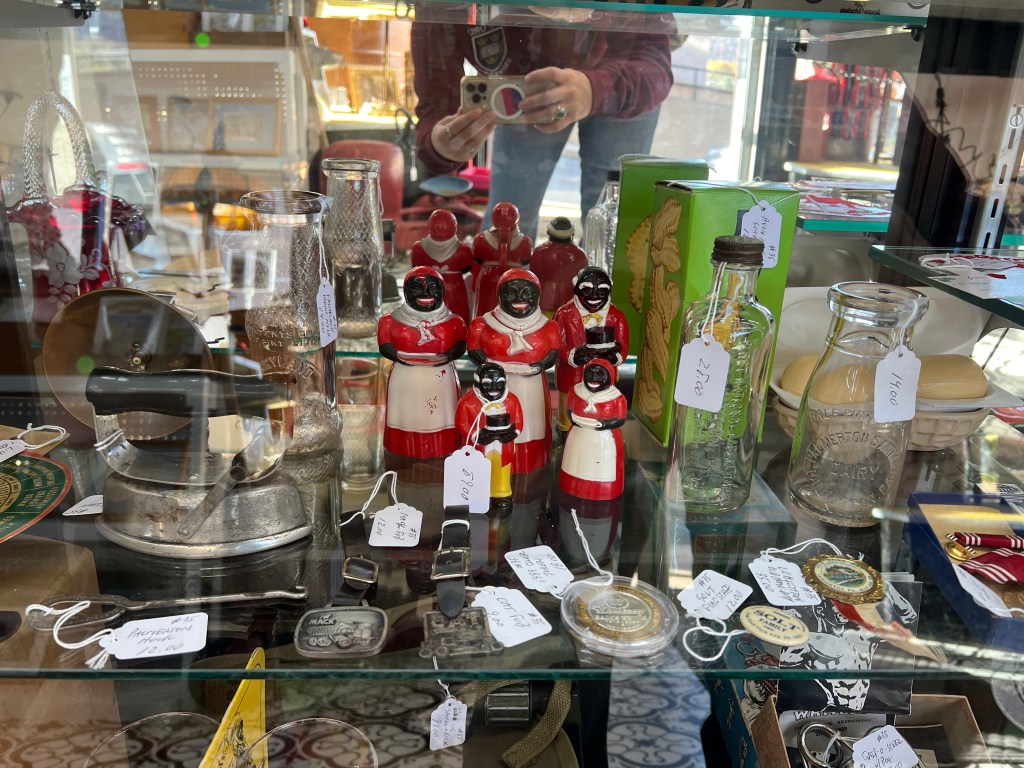
Reader, please be warned. This blog post includes pictures of racist antiques, included for discussion.
Two weeks ago I found myself in Carbon County, PA after a failed attempt to find parking in Jim Thorpe. Bad planning cast aside, my partner and I regrouped and continued driving towards Lehighton in search of antiques and a good meal. We found both.
The meal was French onion soup and a Blue Moon, but that’s not important. I want to talk about history through collected objects.
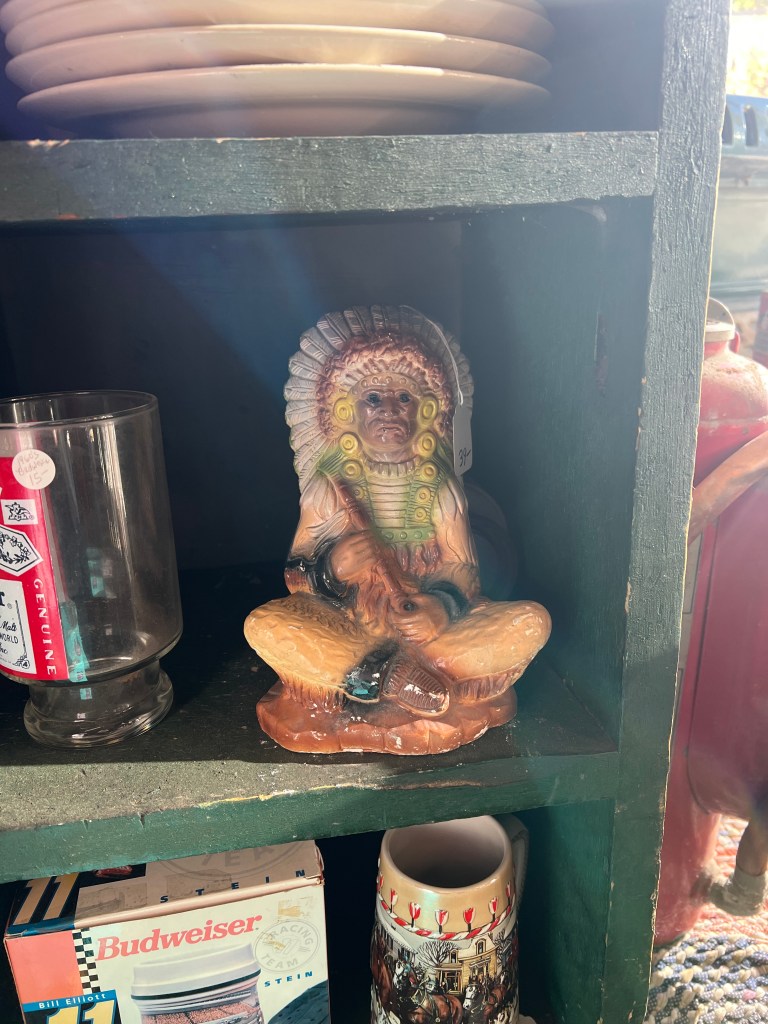
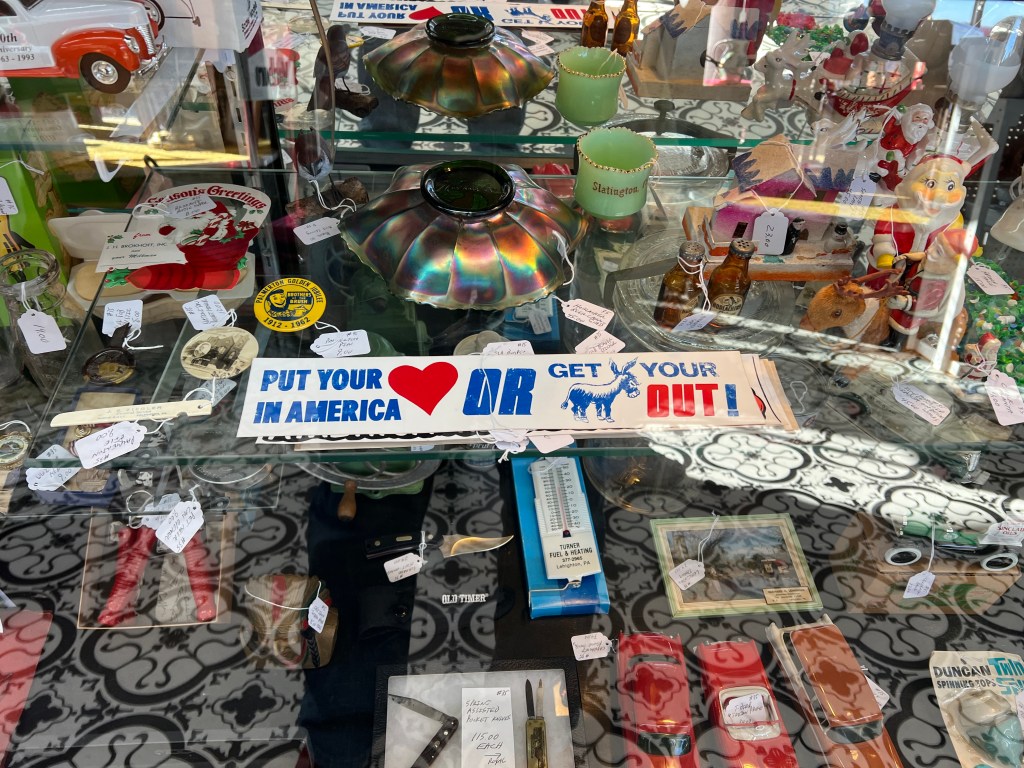
Antique stores are always a crap shoot because you may find a treasure trove of valuables, or you could be wading through garbage. The stores we found in Lehighton had a little bit of both, with old VHS tapes of the Johnny Carson show alongside Hess trucks… and a healthy dose of racist memorabilia… caricatures of Native Americans. Don’t worry, I’m desensitized. Par for the course!
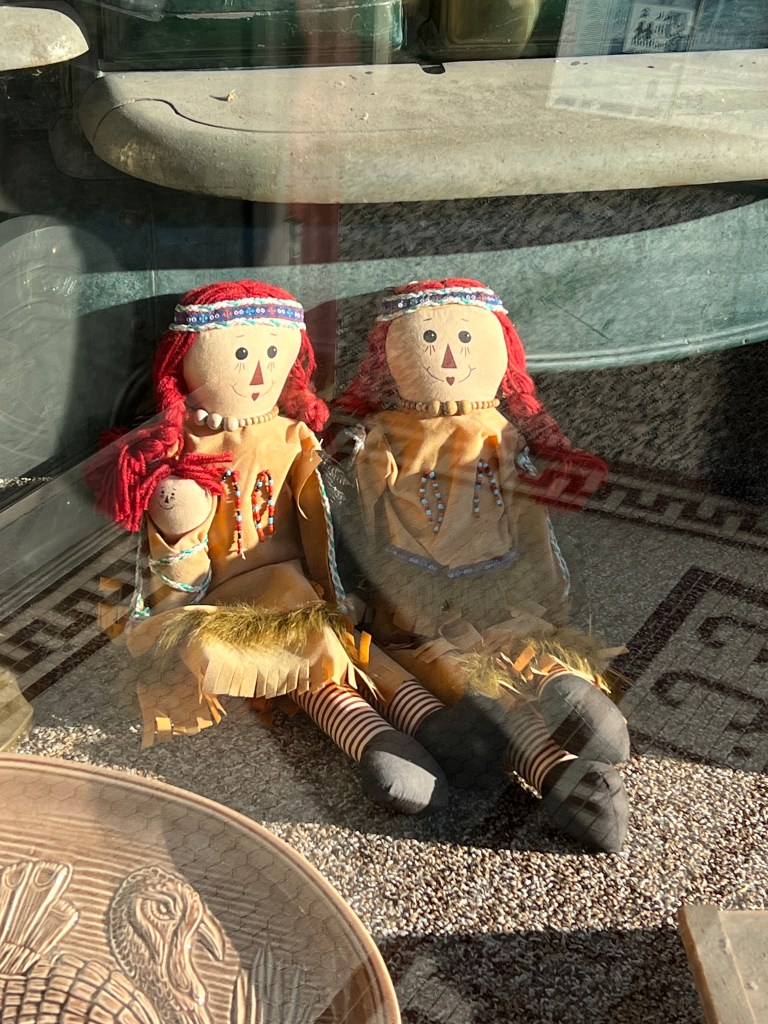
Amidst the junk, there were charming odd things, a chair or two, dozens of old lamps, and plenty of old toys. I’m not interested in buying creepy dolls or dirty china, but I was touched, as I always am, at the idea that the shop owners were paying to house, perhaps indefinitely, mountains of old things. They must know that nobody wants some of this. I shudder at the idea that people are coming to the store to buy some of the racist tchotchkes; those things might be destined to either sit on the shelf gathering dust or end up in a landfill. But still! They wait to be sold!
In my head, this touches on relationality. As a Shawnee woman who grew up in a city, I have long felt disconnected from the ways Native Americans have historically related to our environment. Honestly, I have more experience hearing about relationality or reading about it than existing within that paradigm. But from what I have been able to begin to piece together, it’s fundamentally different from the way our colonized minds have thought about resources. As Atun-Shei Films argues in his video essay “Did Native Americans Really Live in Balance with Nature?”1 colonizers, as well as the Western religions they brought to the Americas, have generally supported the idea that resources, both human and non-human, were ours to exploit and use. The idea that everything has an inherent value is paradigmatically opposed to this structure.
I see something like that in these mountains of junk. We haven’t tossed them; their persistence implies that they have value. And while as a society we have tended to toss anything unwanted into the furnace, antique stores thrive and make their profits on the idea that even old items have value.
Recycling waste is another part of this conversation. I once had a friend toss recyclable materials into the trash bin, claiming that the recycling is not recycled anyway. While I was (and still am) appalled by the idea of tossing everything straight into the garbage can, their statement was true to a certain degree: the MIT Technology review found that a measly 5-6% of our plastics are being recycled every year. While a supremely accurate measurement is likely hard to come up with, certainly not everything is adequately reused.
But does that mean we should throw everything into the trash? I think not. I believe our mindset towards waste and value matters just as much as our actions. Part of the issue is that globally, we are still convinced that we can continue to use resources infinitely, provided that the consequences are out of sight. Our fight, then, is to embrace relationality as a guiding principle for how we reconsider resource usage.
I claim nowadays that even if you have no choice about where your waste goes, there is a tiny bit of value to the performative act of putting something in the recycling bin, if it can go there. Through it, you’re acknowledging there is life in the object yet, which is a step further than the mindless act of tossing everything into single-stream waste. Considering a reuse for the object involves considering if it needs to go into the bin, and it places value within the object and your own actions towards it. That is a good thing, however small. Yeah, I believe in snowballs bringing about avalanches.
I was also curious about how strongly I responded to different things in the store—-in fact, the very object that inspired this post was a doll. This is not entirely surprising; those who know me well are well aware that I am a sucker for any marketing that involves cute animals. Growing up, I refused to give any of my toys or stuffed animals to charity because I was worried the toys would feel hurt that I was letting them go. I’m not alone: there is a Reddit thread where users discuss whether plushies have feelings. I wonder, is it easier for us to imagine inanimate objects as feeling, valuable things when they are somewhat anthropomorphic in nature? Personal experience suggests yes, as I felt sad about the lonely doll but not the dusty chair in the corner.
I realize I can’t propose that we solve the global waste crisis by telling everyone to imagine they are throwing away their teddy bear and asking them how the teddy bear feels. “Imagine that’s how the trash feels when you waste it instead of reusing it meaningfully.” Ineffective as it likely is, it’s also a drastic oversimplification of relationality as a concept. But there is already a bit of precedent for people looking to Native Americans to help us conceptualize sustainability. Environmentally conscious folks are trying to use everything thoughtfully like how Native Americans “used the entire buffalo.”
It’s hard to be overly prescriptive about how precisely to solve this… plainly, I’m in favor of throwing a lot of the racist junk away. Sadly, not everything is useful, and not everything is designed to last. But maybe we can take different tactics as we think about approaching behavior change in society. Maybe we can imagine ourselves in the environment, as a first step to relating to it.
Endnotes:
1 Plenty of fodder here for another lengthy post. But I’ll leave it for now. Go and watch; it’s interesting.
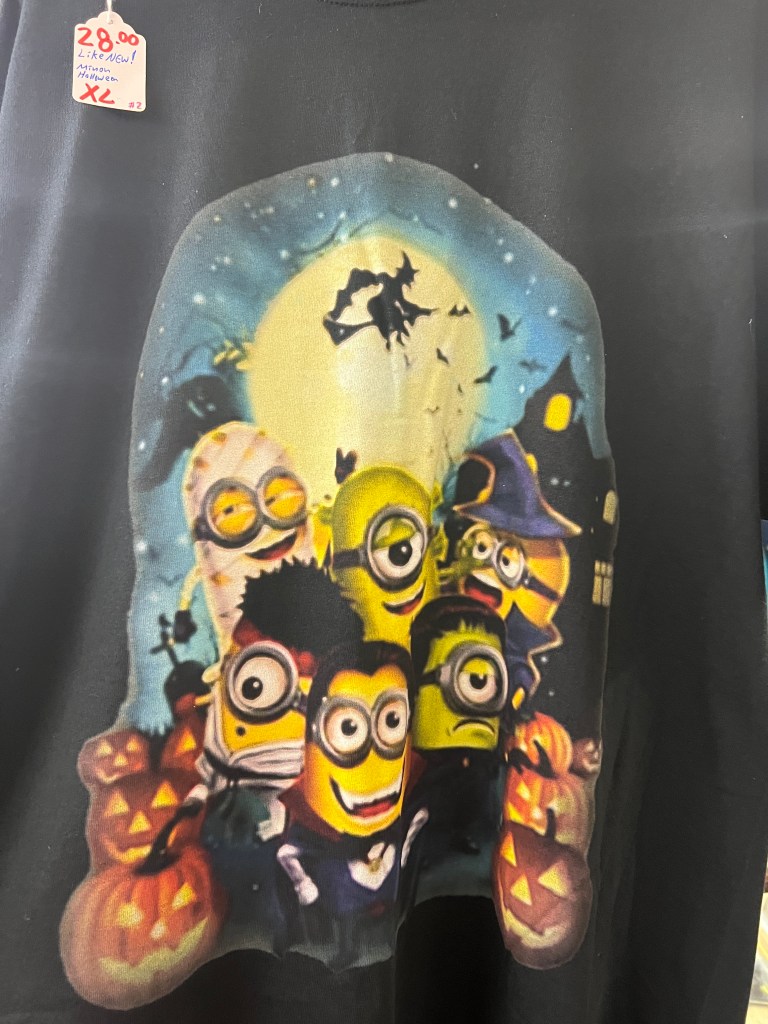
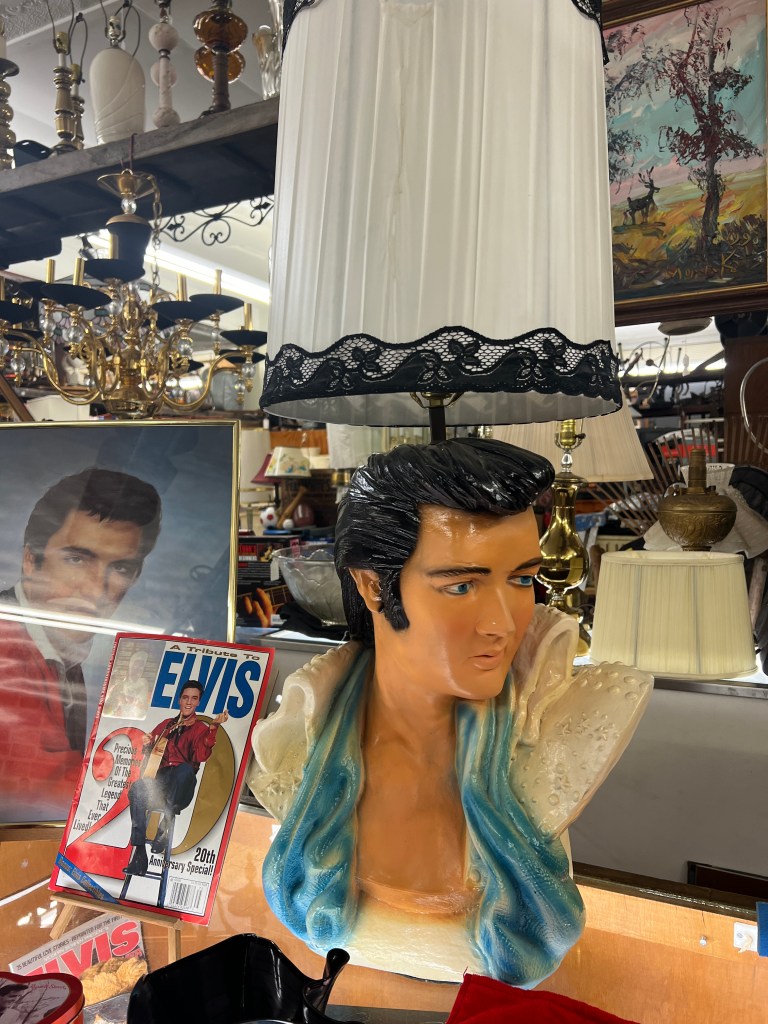
Photos of my findings:





Yeah.
 Native City Girl
Leave a comment