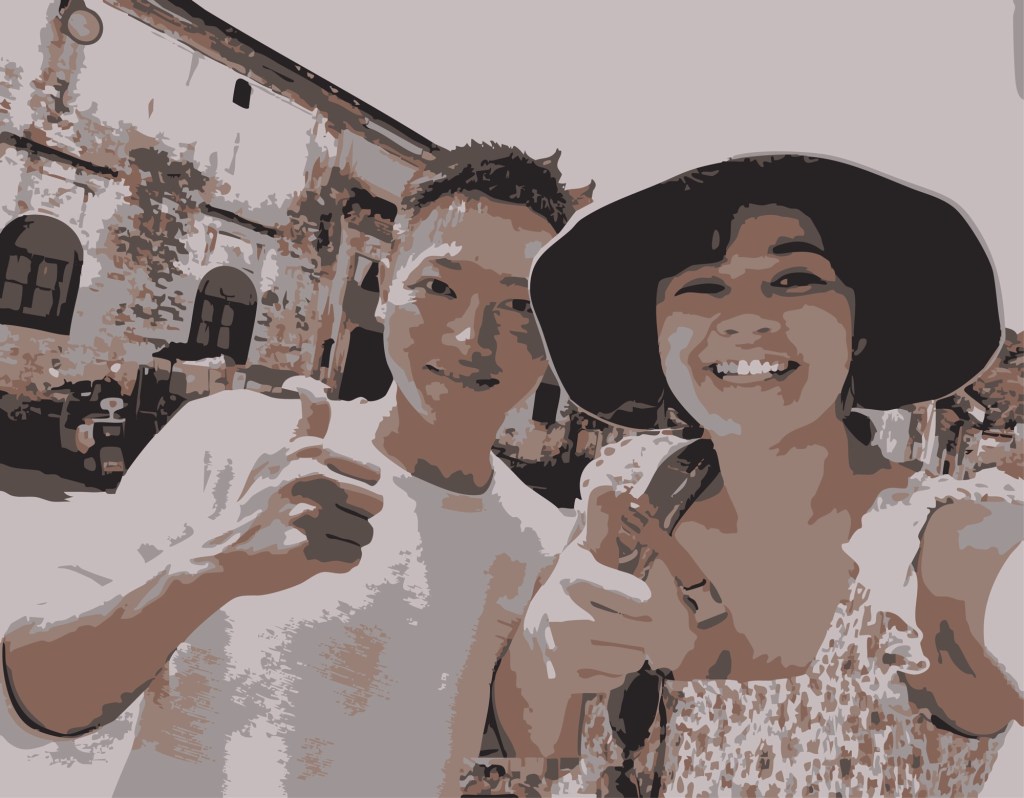
Greetings from Nanjing, China. I’ve been in the country for two weeks now and I am struck by how different things are while simultaneously being entirely the same. Toilet paper and food notwithstanding.
It is generally antithetical to my practice to describe anything as universal. Yet in the time I’ve spent here, the practice of getting to know people, crossing linguistic barriers and cultural practice, is pretty consistent with my own time in America. People want to hear and be heard, listen and talk back. They want to ask questions! They love to hear what’s different, and they especially love to know what is the same.
Everywhere I’ve travelled, both in China and outside of it, I’ve generally found a sweet curiosity about what life is like for me and my family. In China, folks have been especially curious; I have been approached while sitting and sketching, while eating, and while walking down the street. Sometimes there is no English (which is understandable, since I don’t speak more than 10 words of Mandarin) and I and the stranger content ourselves with waving and smiles. Sometimes, though, we manage to whip out the translation apps and have a small conversation.
What are you doing?
What are you drawing?
How do you like China?
You are very welcome here.
The most transformative conversation during my stay here took place in Huangcun, a small village of about 800 people in Anhui province. I was sketching the village when I was approached by a curious local by the name of Ye, who wanted to know if my sketch was good (it wasn’t). He then asked if I was American, and he was brave enough to try a bit of English. I told him that I study architecture, that I liked his village, and that this was my very first time visiting China.
After some small talk I felt comfortable asking him the question of my trip: if someone were to design something new for your village, what would you want that to be?
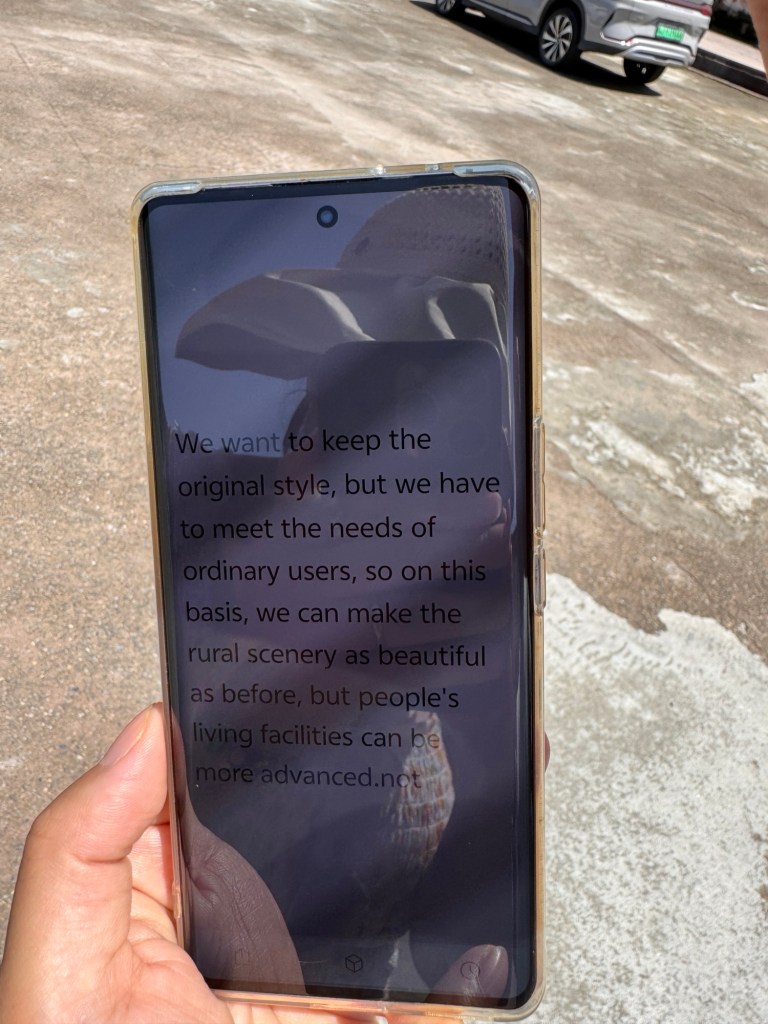
We used WeChat to answer the question, and soon enough we had a full discussion about his concerns and preferences. Using translation apps, we were also able to interview a fellow local and the village carpenter, both of whom had recently retired.
The content of what they told me will naturally inform the design I develop for our rural intervention—the point of my trip to China. But the experience of talking to them proves some points beyond a two-week design charette. Talking to people is really frightening when you feel unfamiliar with the culture or language, but it’s especially critical in this exact circumstance: this unfamiliarity all but guarantees the designer lacks necessary cultural familiarity to design solutions for the constituent community! The discomfort is perhaps all the more reason to talk.
This may seem a stretch, but I have found that my experience in talking to Native Americans helped me adapt to talking to rural Chinese. Maybe my experience tinted my glasses, but it wasn’t that hard. People want to know you, and they need to trust you in order to feel comfortable providing personal information.
In alignment with earlier discussions on relationships, I deferred to my conversational outline:
Build Trust. Provide information in exchange for questions; be willing to trade information with people. Before asking any questions, I establish who I am by answering pretty much every question someone has for me.
Tell Stories. I use some stories to relate to people, some to answer questions about my life. When appropriate, I make contextualizing comparisons with my own life. This is more easily done without significant language barriers, but with a commitment to dictate-translate working, it’s still possible.
Ask for Connections. 90% of my interviews are achieved by asking for a reference to someone else who would be good to talk with. My first friend in Huangcun introduced me to a second and a third. If I had stayed the entire day there doubtless would have been a fourth and fifth. This experience has translated well from my work in North America, where connections run deep and there is always another person willing to tell a story. This tactic is also particularly useful in places where building trust is slow and difficult—-a personal reference can save time establishing trust.
It is very odd to find so many similarities, especially when overlap may be unexpected. But I have been convinced that generosity and talking can get you far in lots of places.
I’ll be back in the States soon!
NativeCityGirl

 Native City Girl
Leave a comment